
Notes from the center of the labyrinth
An unexpected full-circle of Muppets, David Bowie, and Addiction. 💫
WARNING: There are a great number of spoilers in this article, so I suggest if you haven’t yet seen the movie Labyrinth, that you drop everything and watch it now.
As a child of the 80s, I loved all the weird fantastical films like The Princess Bride, The NeverEnding Story, and less-remembered productions like The Peanut Butter Solution and Faerie Tale Theatre…
Without question though, the story that topped them all was Labyrinth.
Starting at about second grade, I would beg my mom to host a slumber party for my birthday with decorate-your-own-cupcakes in place of a singular cake. [This was mainly a ruse to eat as much frosting as was humanly possible.]
With sleeping bags spread all over the living room floor, I [lovingly] forced my little motley crew of elementary school friends to watch the movie Labyrinth three years in a row… maybe four.
Nobody remembers the exact count of showings, but consensus is that it was “a lot.”
😬
I loved everything about that movie. The angsty teenage heroine, the muppet monsters and goblins, and of course, the soundtrack.
The role of the Goblin King was played by the extraordinary and glamorous David Bowie.
While I didn’t understand the complexity of his character back then, or the overall depth of the storyline, I was drawn into that world like I was returning home.
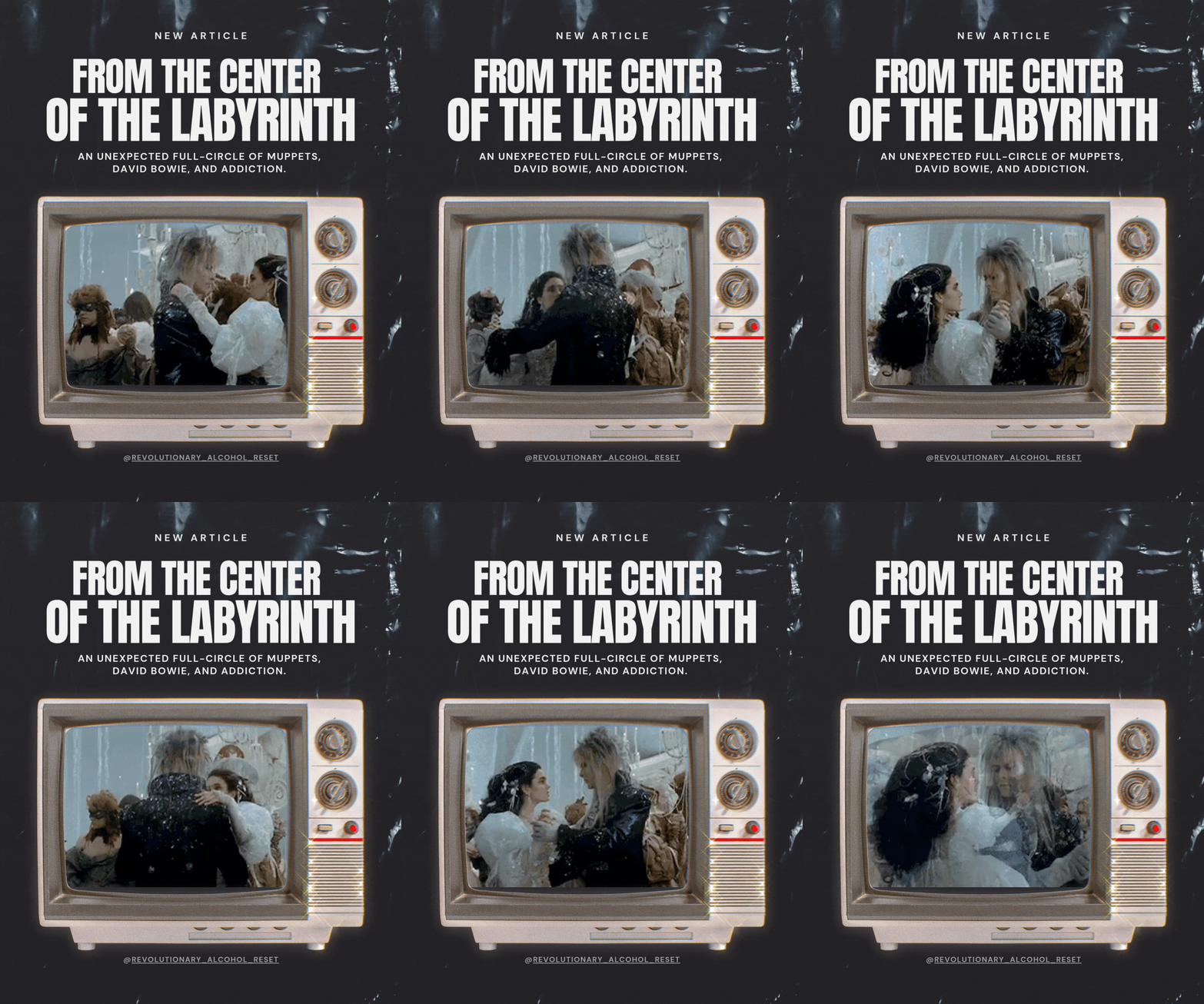
The beautiful, dark glittering magic fit like a puzzle piece in me, and that scene with the masquerade ball was the epitome of my 80s little girl dreams.
There were two lines that always stuck out to me
The first is towards the start of the film, when Sarah stands at the edge of the labyrinth — puffed with confidence to hide her fear — and she says:
“Come on, feet!”
Ugh.
Listen, I get it. She’s willing herself forward into the unknown…
And I’m not sure why I focused on this moment so intensely back then [or why I thought I was qualified as some sort of film critic?] but that line always struck me as silly. Too simple… somehow out of step with the otherwise smooth coolness, thus far.
The other line that stuck out was one of the very last, when Sarah is standing face-to-face with the Goblin King, at the center of the Goblin City. It’s the line that she always forgets, but finally, and dramatically, remembers.
She looks straight at Bowie with a calm sureness — as if understanding a truth for the first time — and says:
“You have no power over me.”
At that point — with a swell of dramatic, dissonant music — the set dissolves into an escher-wonderland-rabbit-hole, and Sarah finds her herself back in her bedroom in quiet suburbia.
Unlike the first line, I didn’t think this was poor writing or uncool. I just… didn’t get it.
It felt like I was missing something and, in truth, I was.
The narrow perspective of my little mind just wasn’t able to grasp the context… yet.
I’m writing this article to share with you an epiphany I’ve had, now 40 years later:
As a classic hero’s journey — a tale of awakening and growth — Labyrinth is often described as an analogy for the tumultuous transition from child to adult. But surprisingly, and explicitly, I believe it also tracks the experience of breaking away from a coping mechanism, an unhealthy crutch… an addiction.
This epic quest tracks the journey away from alcohol.
You can use the term “sobriety” if you want. I sometimes do. Though I feel like my definition doesn’t match the standard. I haven’t claimed the label of “alcoholic,” and I don’t believe the experience of addiction defines my “identity.”
What started for me as a “break” from booze turned into one of the most revelatory and expansive transformations of my life.
In hindsight, I can now see how Sarah’s path through the labyrinth runs parallel to my own. Which, to be honest, even as harrowing and bleak as it’s been at times, fills my little 80s heart with glee.
The set-up
When we meet Sarah at the beginning of this movie, we find her in those torturous teenage years. The opening scene shows her dressed the part of her favorite heroine — reading from a well-worn script, reciting lines in the park. She’s lost track of time and when she arrives home late, she gets into a snotty argument with her stepmother before stomping upstairs. A few times early on, we hear her whiny tagline: “It’s not FAIR!”
Sarah seems intensely annoyed by the limitations of her life and is desperately seeking freedom. She wants to escape the confines of her existence and immerses herself in the worlds of books and stories instead.
My parallel? Well, as a quirky, creative kid in a conservative small town, I never really fit in. I found reprieve from my loneliness back then through tv, movies, and the comfort of junk food. [See: frosting]
When I made it out of high school and finally found “my people” — artists, writers, musicians, and queers — I followed the glittery on-ramp of connection and belonging directly into the nightlife and bars.
What started as a fun activity on weekends over the many years to follow turned into a more and more frequent companion. Drinking became part of my identity.
I loved a big red wine with dinner.
A boozy brunch. Whiskey on the rocks.
A cocktail was my reward after a hard day.
Wine, my way to relax.
I was still leaning on food and tv to “feel better,” like many of us do, but alcohol really took center stage as my favorite escape.
This might sound controversial to some, but I don’t regret my time spent drinking. It’s part of who I was back then, and it was my best tool for coping, before I had the healthier options I turn to now.
But I do regret one thing: I regret not knowing what I was getting myself into.
I regret the naïveté that led me to believe I could outsmart addiction, and that prevented me from seeing the truth about the toxic liquid that saturated my life.
Back to the story.
Jareth: Temptation and escape
Sarah gets so frustrated and resentful of the rules imposed by her parents that she actually summons the Goblin King from one her stories [enter David Bowie wearing eye shadow and tights — meow] and strikes an inadvertently intense deal.
Jareth [Goblin-King-Bowie] is a dark, towering, and smoldering character. Alluring and yet frightening all at once.
He grants Sarah’s wish for freedom — in this case, a life free from the shackles of babysitting — by whisking away her baby brother Toby [who has been tormenting us all with his incessant crying] to live with him forever in the Goblin City.
Sarah immediately regrets this decision, but Jareth informs her that “what’s done is done.” If she wants her brother back, she must make her way to the castle, at the center of the Goblin City — at the center of a sprawling labyrinth — to reclaim him.
We’re then transported to a strange new world with a dusty path. The castle in view is made hazy by the distance, and cue the fateful line:
“Come on, feet.”
🙄
Hoggle: Getting to know our inner voice
As Sarah approaches the gate, we meet our first companion: a squatty gnome with a haggard face and a bad attitude. Hoggle is our first reality check… the first indication that this land of fantasy isn’t going to be full of unicorns and wishes. In fact, he’s diligently working to exterminate a swarm of pesky, biting fairies.
Hoggle tries to dissuade Sarah from entering the giant maze with a pessimistic concern, but she’s not convinced. Sarah steps forward through the gates as Hoggle warns: “Even if you get to the center… you’ll never get out again.”
This life of fantasy — Sarah’s escape — is her addiction.
The quest through the maze — her process of healing.
The rest of this movie — underneath the sparkle and puppetry and clever bits of humor — represents a teenager growing up, yes. But I also believe it reflects a poignant and direct experience of coming home. The process of embracing our authentic self. Learning to set down patterns of self-protection and coping and finding courage to face the parts of ourselves we’d rather not claim.
Sarah’s journey to the center of the labyrinth is a brave and daunting choice to challenge her habit of escape — to pursue a nagging feeling that this fantasy world may not, in fact, be freedom… but rather something darker. Another sort of prison dressed in different, magnificent clothes.
Hoggle, in my view, is Sarah’s inner critic. The [grumpy] voice in her head that tells her not to try. “It’s too hard.” “You’re going to fail.” That part of us that thinks it’s better to stay in the realm of “the known” — even if “the known” is unsatisfying or unfulfilling — simply in order to stay safe.
Hoggle speaks in pessimistic extremes: “That’s just how it is,” and “You’ll never make it,” …a tell-tale sign of the critic.
Sarah: Ow! It bit me!
Hoggle: What’d you expect fairies to do?
Sarah: I thought they did nice things, like… like granting wishes.
Hoggle: Shows what you know, don’t it?
In my journey away from alcohol, my inner critic was the first to show up.
The concept of an inner critic is commonplace, right? If you’d asked me if I had one, before this adventure in healing, I would have said absolutely: yes.
But my understanding back then would have been limited.
I knew I was hard on myself — often holding myself to standards I’d never impose on others. But I wasn’t tuned in to the specifics of the soundtrack of worried, anxious, limiting beliefs that this character was lobbing my way, day-in and day-out.
Learning to identify that inner voice — and get some distance from it — has been one of the most powerful components of this journey back to myself. Understanding, befriending, and even appreciating the part of me that wants to keep me safe… but reclaiming the choice between fear and truth.
Not all risk is meant to be avoided.
And not all comfort zones hold safety.
So, we’re in the labyrinth now, and Sarah meets all kinds of characters and delays. This maze is full of puzzles.
Hoggle continues to appear in times of struggle, offering almost incessantly to take Sarah back to the beginning — offering her a way out, and a way back to the safety of life as it was. But our heroine is pulled forward by her mission. She can hear Toby’s cries in the distance and something in her just can’t leave him behind.
Ludo: Befriending shame and guilt
After a few twists and turns and some time spent in an oubliette, we meet a beast: a larger-than-life, furry, fanged, imposing [and ultimately gentle] giant.
Ludo is hanging from his feet being tormented by a little gang of goblin soldiers — protesting and howling. When Sarah frees him and offers friendship, we immediately see that he’s a nice beast.
I believe that Ludo, like the ever-present elephant in the room of our minds, represents the monster of shame and guilt. A big, hairy embodiment of the parts of ourselves we’ve made “wrong” [and so hide away and punish].
As we get to know this monster, it becomes clear that he’s not a beast to be feared, but rather a tender character who needs connection and love.
Ludo: Ludo scared.
Sarah: Come on, give me your hand. Imagine, a big thing like you, scared!
Befriending this part of ourselves plays a huge role in healing addiction. Not only can we carry judgment about our perceived inadequacy or lack of “self-control” regarding our coping mechanism of choice, but it’s quite possible [if not guaranteed] that we’ve turned to coping in the first place because of the internal feelings of guilt and shame we’ve built up over the course of our lives.
For me, growing up as an outsider led me to classify all sorts of qualities as “wrong.” From a very young age, there were parts of me that I hid away — shoved into the shadows — in an effort to fit in and belong. As I stepped away from alcohol and took a good, hard look at myself, I saw the pain I’d created in doing so, the sadness and grief I’d caused in banishing those pieces of me.
By reaching out to those monstrous parts and offering them acceptance and love, I’ve found a surprisingly strong sense of wholeness. Peace.
With Ludo and Hoggle by her side, Sarah continues through the maze.
Sir Didymus: Ego and self-protection
The next adversary of note is a scrappy little fox-terrier-like character. Sir Didymus guards the only bridge over an intensely stinky swamp, and I’m fairly certain that this fella represents our ego: the prideful, somewhat deluded part of ourselves determined to PROTECT OUR SENSE OF SELF AT ALL COSTS. (…logic and reason be damned!)
Ludo and Didymus are a match in battle, but it’s not until they lower their fists and come to a place of respect [and friendship] that a solution is found.
Sarah: Okay, let’s handle this thing logically. What exactly have you sworn?
Sir Didymus: I have sworn with my life’s blood, none shall pass this way without my permission!
Sarah: Well… may we have your permission?
Sir Didymus: Well I, uh… I… that is, uh… hm………. yes?
The crew makes their way out of the Bog of Eternal Stench…
— Hoggle fled back at the first sign of trouble, by the way.
— Ludo proves to be a legitimate source of strength.
— And Didymus, ever determined to prove his bravery and might, challenges anything that moves.
With each step, and each hardship overcome, Sarah is becoming more confident. She’s letting go of old beliefs, loosening her grip on expectations and control, and stepping into a more flexible — powerful — determined sense of self.
Mixed messages and mindset shifts
There’s potential symbolism and relevance in every scene of this film. To touch on a few more:
— The Little Worm who helps Sarah access an early perspective shift.
— The Little Guys under the tiles who mess with Sarah’s markers.
— The stone False Alarms that get louder as you head in the right direction.
— The riddling Door Guards and Door Knockers who may be telling us there is no “right way.”
— The Cleaners, the “Helping” Hands, and the dark, black oubliette are just a few of the setbacks on this winding path.
— The reckless Fire Gang who tries to tempt [and threaten] her to join them.
— The Junk Lady who helps Sarah realize what really matters. [More on her later.]
— And, of course, the Wiseman and his Hat.
The Wiseman: Quite often, young lady, it seems like we’re not getting anywhere, when in fact…
The Hat: We are!
The Wiseman: …we are.
The Masquerade: Seduction and deception
A key point in the film is when Hoggle — under the threat and control of Jareth — hands Sarah a poisonous peach.
The Goblin King, you see, has been orchestrating each and every obstacle along Sarah’s quest. This is his world. He’s calling the shots and pulling the strings; conjuring the pretense of “helping” Sarah in some way, when the end goal is actually to control her.
This character in tights is the embodiment of her addiction. Which is exquisitely, deliciously depicted in the scene that captivated my frosting-loving little self: the masquerade.
In this scene, while Sarah is under the spell of Jareth’s poison, she finds herself in a ballroom among a crowd wearing ghoulish masks and lavish gowns. She’s swept into the music as Bowie takes her hand — with eye contact a tad too intense for a teen [ahem] — and croons:
“As the pain sweeps through
Makes no sense for you
Every thrill is gone
Wasn’t too much fun at all
But I’ll be there for you-ou-ou
As the world falls down…”
He’s offering her the freedom she desires: respite from the cruel world of routine and rules.
The masks in this scene hold a particular relevance as I reflect on the past.
I was wearing so many masks in my life before, like many of us do. I was pretending that I was one way or another — only showing the world curated parts of myself. I was people-pleasing and over-achieving — pretending everything was fine.
Keeping a busy schedule was a convenient way to avoid my life. And alcohol was the consolation prize — a sexy, ruby red escape hatch from the monotony and hustle. It allowed me to push pause on deeper, unsettling thoughts — kept me coasting along the surface.
I thought that booze was the duct-tape holding my life together, but now I see it was the glittering mirage holding me back.
When I took a break from booze, and the chaos in my mind started to settle, I was able to see my life more clearly. I could see myself again.
Slowly, one by one, I started putting down those masks and reconnecting with my true feelings, hopes, and dreams… untangling myself from pleasing and achieving. I worked to set boundaries and reshaped my relationship with rest.
We’re all imperfect beings.
And we can all wear masks.
We sacrifice our needs for the sake of belonging. Or success. Or a sense of purpose.
But a hard truth I had to learn was that it’s only as our authentic selves that we find acceptance. Only when we put down the masks can we experience true belonging and happiness.
We’re not sure how much time has passed, but as the clock strikes, Sarah comes to her senses and shatters the bubble of this masquerade illusion — determined to make her way to the center of the labyrinth. To take back the child who’s been stolen.
Through dangers untold: Redefining priorities
Before Sarah can even take a single step forward, the world of fantasy throws yet another test her way — the addiction grasping again for control:
The Junk Lady tries to lure her back into her old life by holding up all the things Sarah held precious, the “little things” in life that were once priorities: trinkets, books, toys…
Like a blurry picture coming into focus, Sarah has a revelation that none of this stuff really matters.
The Junk Lady: What’s the matter, my dear, don’t you like your toys?
Sarah: …..it’s all JUNK!
In my own life, these were all the little fleeting moments of [what I used to think of as] joy — surface-level “rewards for adulting” like cocktails after work, french fries paired with champagne, and a glass of white wine in the Nordstrom’s bar.
The voice of temptation would say “You deserve this, don’t you?” “This makes you happy! You don’t want to miss out on this in your life, do you?”
And, just like Sarah, when I really thought about it, and when I got enough distance from all of those addictive little hits of dopamine, I realized that I was no longer satisfied skimming along the surface of life… that the things that truly mattered to me lie deeper.
Hardships unnumbered: The final battle
As our hero makes her way through the gates of the Goblin City, she battles an army of goblins with the help of her little crew: Hoggle plays defense, Ludo calls upon his friends the rocks, and Sir Didymus spews [loveable] bravado at everything in his path.
The goblins are Jareth’s little minions — protecting his empire and doing his bidding.***
***An interesting sidenote here is that Dr. Anna Lembke — author of Dopamine Nation — uses an analogy to describe the chemical process of addiction in the brain with substances like alcohol, nicotine, and even sugar.
This analogy involves a teeter-totter with “pleasure” on one side and “pain” on the other. Pain, in this description, is characterized by what Lembke calls little hormonal “gremlins.”
For a quick summary of this teeter-totter process, check out this short video.
The climax of the movie occurs as Sarah steps into the castle. She asks her squad of allies to let her confront the Goblin King solo. With a sweet expression of gratitude for all they’ve done for her, she heads up the stairs.
After a few more twists and turns — literally a scene inspired by M.C. Escher — and another song by Bowie, Sarah finally finds herself face-to-face with her addiction: the seductive and dangerous figure who is desperately trying to keep her ensnared in his world of fantasy and escape.
Sarah looks straight at Jareth with a calm confidence, as if understanding this truth for the first time:
Sarah: Through dangers untold. And hardships unnumbered. I have fought my way here to the castle, beyond the goblin city, to take back the child that you have stolen. My will is as strong as yours, and my kingdom as great…
Jareth: Stop! Look what I’m offering you. Your dreams.
Sarah: My kingdom as great… my kingdom as great… damn, I can never remember that line.
Jareth: Just fear me. Love me. Do as I say, and I will be your slave.
Sarah: You have no power over me! […power over me… power over me…]
As mentioned before, I absolutely did not get the significance of this line back when I was binge-watching as a kid.
Now, as an adult in my 40s, having just navigated my own labyrinth of challenges and darkness and transformation, it finally clicked.
To take back the child you have stolen
After decades of drinking and the effects of tolerance, I see now how distanced I’d become from my true self. Disconnected from my intuition.
Toby represents our inner child. The child that lives in all of us is our source of play, lightness, and creativity… and alcohol steals this from us.
Alcohol initially seems to be adding to our experience of life but slowly, over time, turns everything a dull gray. It’s a mask. A dangerous illusion. A shiny, sexy pop star who’s actually a puppetmaster… offering us relief, escape, and fantasy in exchange for our freedom.
My will is as strong as yours
When you start to question the fantasy, its power begins to fade… but the world of escape puts up a great fight to keep you tethered!
It tries to tell you that life is better this way.
That you need it to survive — you can’t do this alone.
You’ll feel scared to let go, because it feels so familiar.
And change seems unstable and unknown… or maybe just less interesting?
But here’s the kicker:
Once you step out from under the thumb of addiction,
And you reconnect with all those parts of yourself that you’ve been running from…
When you offer yourself the love and kindness and rest that you’ve been withholding in your determination to “keep it all together”…
You find a whole new life. In full color.
With interesting characters and beauty and play.
My kingdom as great
In my life now, I feel anchored to a deep sense of self-trust.
A cool, calm confidence in who I am and what I believe in.
I feel lighter, with more access to contentment and peace.
I no longer “need” booze to relax.
I don’t “crave” wine with my meals.
I’ve shattered that bubble of illusion and I now live joyfully in the complexity of truth.
I’m no longer coping with life, I’m actually living it.
And I no longer feel the pull of temptation from alcohol…
It has no power over me.
Embracing an authentic life
Now, I’m not saying that my current life is perfect, but it feels less chaotic. More balanced. Even the hard days feel less hard.
I’m still meeting new parts of myself and working to untangle an entire life’s worth of patterns… and I feel so grateful. This clarity of mind, healthy body, renewed sense of lightness and peace.
True happiness.
I wouldn’t trade this for anything.
The clock chimes 13 and the castle dissolves, and Sarah finds herself back in her bedroom in sleepy suburbia. Her parents are still out for the evening, and little brother Toby is asleep in his crib.
Sarah looks in the mirror and sees her loyal companions reflected behind her…
Ludo: Goodbye, Sarah.
Sir Didymus: And remember, fair maiden, should you need us…
Hoggle: Yes, should you need us… for any reason at all…
Sarah says: “I need you, Hoggle! …every now and again in my life, I need you. All of you!”
And a Muppet goblin dance party ensues! The Goblin King watches this reunion from outside the window before he flies away into the night.
Labyrinth remains my favorite movie of all time. And this full-circle moment in my life — this echoing storyline — seems mysterious and magical and absolutely…
perfect.
If you’re ready to start your own hero’s journey towards a beautiful and empowered life, you can get started today with my 6-week course:
